
Auth Foundation: Building Better Auth, Creem Billing, and Email Infrastructure for Shipping API Dojo v2
Auth Foundation: The Infrastructure That Makes Shipping API Dojo a Real Product
Issue #11 is now complete. The auth, entitlements, billing, email, and domain foundation for Shipping API Dojo v2 is in place on the feature branch codex/issue-11-auth-foundation.
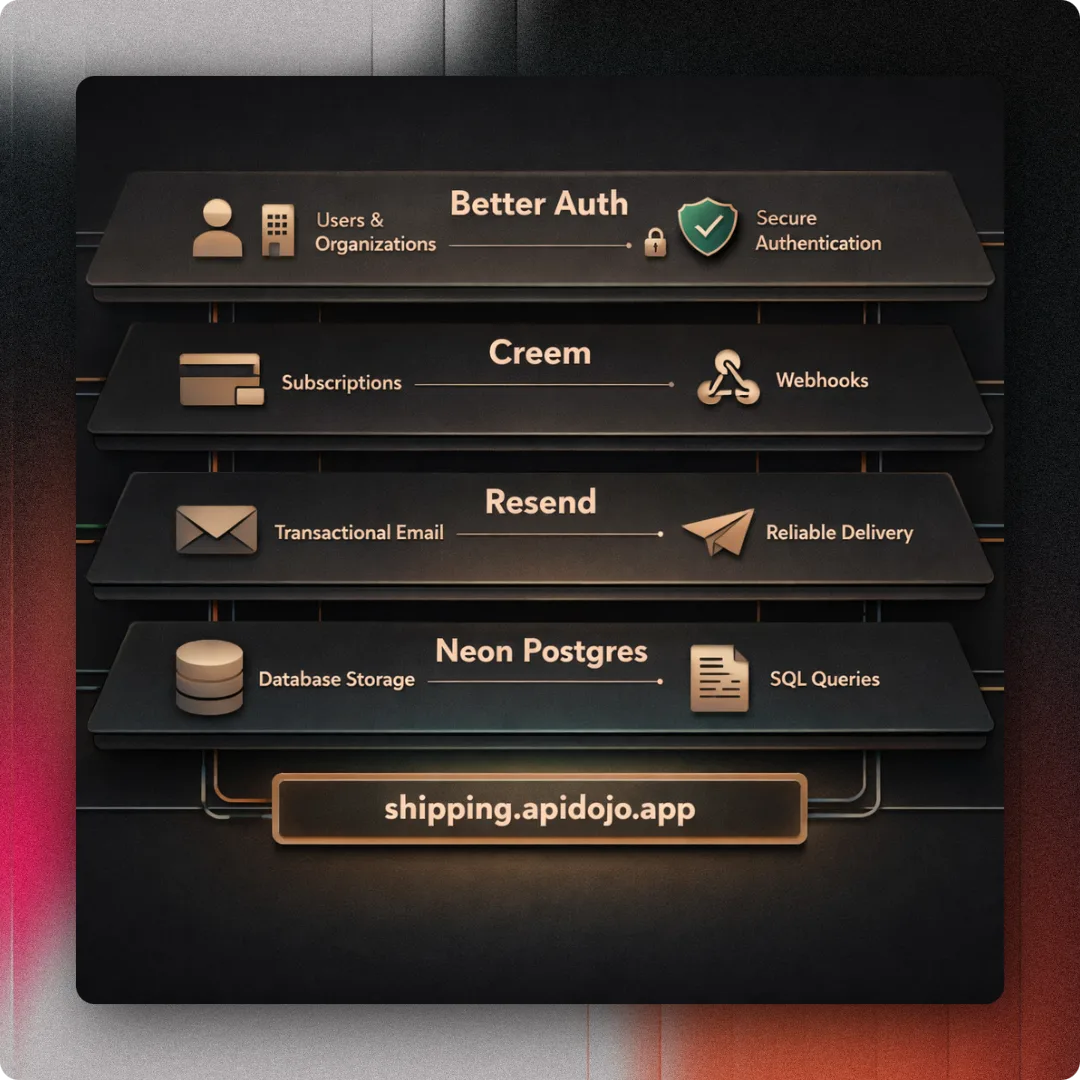
This is the infrastructure that enables Shipping API Dojo to become a real product. Better Auth for authentication. Creem for billing. Resend for email. shipping.apidojo.app as the production domain.
This is how the implementation went.
Better Auth: authentication and organization management
The authentication layer is built on Better Auth. The decision to use Better Auth came from the technical scoping phase—it was the right fit for the requirements:
- User accounts with email/password and OAuth (Google, GitHub)
- Session management handled by Better Auth
- Organization/tenant model for multi-product support under the apidojo.app umbrella
- Magic link tokens for passwordless flows
- Verification table for email confirmation and other token-based workflows
- Smooth integration with Creem with great documentation and SDK
Better Auth manages several tables automatically: user, session, account, verification, organization, member, and invitation. I mapped these to custom table names where needed—organization becomes tenants, member becomes tenant_members—to align with the apidojo.app multi-product vision.
The auth configuration also includes custom additionalFields:
- On users: terms_accepted_at, privacy_policy_accepted_at, deleted_at
- On tenants: plan, seat_limit, default_currency, billing_status, creem_customer_id, creem_subscription_id, current_period_end, settings
This is where the billing integration starts to take shape.
Creem: merchant of record for billing
Creem replaces earlier Polar assumptions as the merchant of record. Creem handles invoicing, tax, payments, refunds, and chargebacks. It's very developer-friendly and has no fixed costs. I handle the product logic and entitlement enforcement.
The billing state lives on the tenant record:
- creem_customer_id: links the tenant to their Creem customer
- creem_subscription_id: links the tenant to their active subscription
- billing_status: tracks the subscription state (active, past_due, canceled, etc.)
- current_period_end: when the current billing period ends
I also introduced two new tables for Creem integration:
- creem_products: maps Creem product IDs to internal plan keys and module slugs
- creem_webhook_events: provides idempotency for webhook processing
The webhook events table is critical. Creem sends webhooks for checkout.completed, subscription lifecycle events, refunds, and disputes. The unique constraint on event_id ensures I process each webhook exactly once, even if Creem retries the delivery.
Resend: transactional email infrastructure
Transactional email needs a dedicated setup. The foundation includes:
- Dedicated Resend account for API Dojo
- Verified domain under the apidojo.app umbrella, mail.apidojo.app for Resend
- Multiple sender identities on the verified domain
- Transactional email architecture for notifications, receipts, and account-related emails
Resend Free allows one verified domain per team with multiple sender identities. That's sufficient since I use the umbrella domain for all future products.
The email architecture is designed to support:
- Welcome emails and onboarding flows
- Subscription notifications and receipts
- Password reset and magic link delivery
- Product announcements and updates
Domain foundation: shipping.apidojo.app
The domain strategy from scoping is now in foundation:
- apidojo.app is the umbrella/root domain
- shipping.apidojo.app is the production hostname for this product
- mail.apidojo.app is the Resend domain
- DNS configuration for the production hostname
- SSL certificate setup
- Proper canonical URLs and redirect handling
The domain cutover is planned as a controlled site move, not an ad hoc rename. That means proper SEO preservation throughout the transition—redirects, canonical URLs, and sitemap updates.
The apidojo.app umbrella is important. It positions Shipping API Dojo as the first product under a broader API Dojo brand, with room for future sibling products like the planned EDI site.
Server functions and webhook handlers
The implementation includes both authenticated server functions and server-only HTTP request handlers:
- Authenticated server functions for signed-in progress and user-facing operations
- Server-only HTTP request handlers for webhook endpoints that require raw-body signature verification
This separation is important. Webhook endpoints from Creem need access to the raw request body for signature verification. That's only possible with server-only handlers. User-facing operations use authenticated server functions for proper session handling.
Environment variables and configuration
The foundation includes a complete environment variable checklist covering authentication session encryption, callback URLs, API keys for billing and email services, webhook signature verification secrets, and database connection strings.
Every external service integration is documented with its required environment variables. That's the handoff checklist from scoping made real.
What this foundation enables
With issue #11 complete, the infrastructure is in place for:
- User registration and authentication
- Subscription management through Creem
- Entitlement enforcement based on subscription status
- Transactional email delivery
- Progress tracking tied to authenticated users
- Multi-tenant support under the apidojo.app umbrella
This is the foundation that makes the content-family migration in issue #8 and the full content expansion in issue #9 possible. Without auth and billing, randomized learning at scale is just a technical demo. With it, it's a real product.
What's next
The auth foundation is complete. The proof of concept for content families and seeded randomization (issue #8) can now build on this foundation. The full content migration (issue #9) can assume authenticated users and server-authoritative progress.
The browser smoke suite (issue #17) will validate that all of this works together at the route level—auth flows, protected routes, and the core user-visible surfaces.
The infrastructure is ready. Now the real product work begins.
Related Posts

Technical Scoping: How Shipping API Dojo v2 Designed Its Content-Family Foundation
Before building Shipping API Dojo v2, I needed a complete technical blueprint. I scoped content families, seeded randomization, auth/billing/email/domain strategy, and the decisions that shaped the architecture.

Browser Smoke Suite: Cost-Efficient Route Validation for Shipping API Dojo v2
Issue #17 added a minimal Playwright smoke suite to complement unit/integration coverage. I built a cost-efficient browser test layer for checkpoint validation and future mirror sites.

Proof of Concept: Validating Seeded Randomization and Content Families in Shipping API Dojo v2
Issue #8 implemented a proof of concept for minimum viable randomization and content families. I validated MCQ shuffling, lesson drill ordering, scenario sequencing, and SSR-safe behavior under TanStack Start.