
The Memory Bank: Theory, Practice, and Agentic Pair Programming
Earlier in my Agentic Coding Journey I coming back to the same problem when building solo (or in a tiny team): context leaks.
- Code evolves.
- Decisions get made.
- “Why did we do it this way?” fades.
- Then you return two weeks later and either re-derive the same conclusions… or ship a regression.
Now add AI coding agents to the mix and the failure mode becomes sharper: the agent can be extremely competent at local reasoning, but it can’t hold your product’s long-term intent unless you teach it. That’s what my memory-bank is for.
This post documents:
- The theory behind a memory-bank.
- How it works in practice in The Builder Coil.
- How it differs from an older revision I used earlier today on jorild.se.
- The prompting patterns that make it actually usable.
What a memory-bank is (for me)
A memory-bank is structured, versioned project context that sits next to the code and can be read and updated continuously.
It’s not documentation “for the sake of documentation”. It’s documentation as operational leverage.
I want three outcomes:
- Decision persistence: the reason behind a change survives the sprint.
- Planning continuity: work can be resumed without re-triage.
- Agent alignment: an AI pair programmer gets the same constraints I’m carrying in my head.
The core loop: plan → implement → reconcile
The loop I try to enforce is:
- Plan work in a structured format.
- Implement changes.
- Update the memory-bank so the plan and reality converge.
This is especially important for tasks that are deceptively small but highly cross-cutting (SEO, schema markup, deployment fixes, content loader refactors).
In practice, that means I always try to keep:
- A single “what’s active now” file.
- A changelog that records what shipped.
- A place to store implementation plans (current vs archived).
The Builder Coil memory-bank (the newer template)
In this repo, the memory-bank lives under:
specs/memory-bank/active-context.yamlspecs/memory-bank/CHANGELOG.yamlspecs/current-changes/(work-in-progress plans)specs/archived-changes/(completed plans)specs/future-changes/(future and optional plans)
The key design choice is the ID-based tracking system.
An “issue” (often mirroring a GitHub issue) has deliverables like:
I6D1I6D2I6D3
This makes three things easier:
- You can talk about work with precision (no vague “we did the SEO thing”).
- You can link changelog entries to specific deliverables.
- You can summarize progress without rewriting history.
How the memory-bank helped this specific SEO/schema work
This week’s schema work is a good example of why I like the system.
The task was not just “add JSON-LD”. It was:
- Audit what already existed.
- Add missing schema on listing pages.
- Refine semantics (
NewsArticlevsBlogPosting). - Add a global root-level entity graph so AI/search can connect:
- Ball Lightning AB (org)
- The Builder Coil (website)
- Chronomation (product)
Because the memory-bank forces explicit deliverables, it’s hard to accidentally stop halfway.
It also creates a clean story that can be reused later when Chronomation automates this content and needs the same metadata contracts.
jorild.se vs The Builder Coil: why the TBC version wins
Earlier today, I used a slightly different memory-bank structure on jorild.se.
It works, but The Builder Coil version is the one I want to standardize going forward because:
- It has clearer separation between active plan and archived record.
- The ID system makes the changelog and roadmap mechanically consistent.
- It is easier for an AI agent to navigate:
- “What is the current state?”
- “What was recently completed?”
- “What is planned next?”
That last point matters a lot when you use agentic tooling daily.
Prompting pattern: give the agent structure, then enforce reconciliation
Here’s a representative prompt style (based on the jorild.se example), which I often reuse as a template:
My prompt (using SWE-1.5 + Opus 4.5 (Planning):I've already updated the meta version of @package.json, but not of @activeContext.md.Let's add a small update to @activeContext.md for our work adding internal shortlinks using Cloudflare Redirects, internally saved to ops\redirects\bulk-redirects.csv.Run /commitprocess and prepare to commit.Let's also create and subsequently close a small issue to track this as this is a small but important addition.Please also create a separate issue for the Backlog, moving from Prettier to Biome, which is our standard formatting/linting solution starting with the The Builder Coil project.The critical part isn’t the model choice.
The critical part is that the prompt:
- Names specific files.
- Defines explicit outcomes.
- Requires a final reconciliation step.
That last step is what keeps an agent from shipping code that “works” but leaves the project state incoherent.
What I’m optimizing for long-term
The memory-bank is not a perfect system.
But it’s a system that scales down (solo dev) and up (small team), and it integrates naturally with:
- GitHub issues
- PRs
- changelogs
- repeatable workflows like
/commitprocess
Most importantly: it’s the bridge between product intent and code changes.
And that bridge is exactly what agentic development needs.
Next: making it a Chronomation feature
Chronomation’s original purpose was always to turn work artifacts (commits, notes, issues, emails) into narrative content.
A memory-bank is essentially a structured “work artifact stream” already.
Long-term, I want Chronomation to:
- ingest these memory-bank updates,
- propose diffs,
- and publish coherent narrative updates (blog posts, changelog summaries, release notes)
…without losing the precision that makes the memory-bank valuable.
The initial inspiration for my Memory Bank Process is the Cline Memory Bank and it has evolved over the past six months based on that
Related Posts
Building a Shared Typography and Layout System for Three Brands
How I’m designing a shared typography and layout system that unifies The Builder Coil, Chronomation and Ball Lightning—starting from body text, a modular scale, and consistent vertical rhythm.
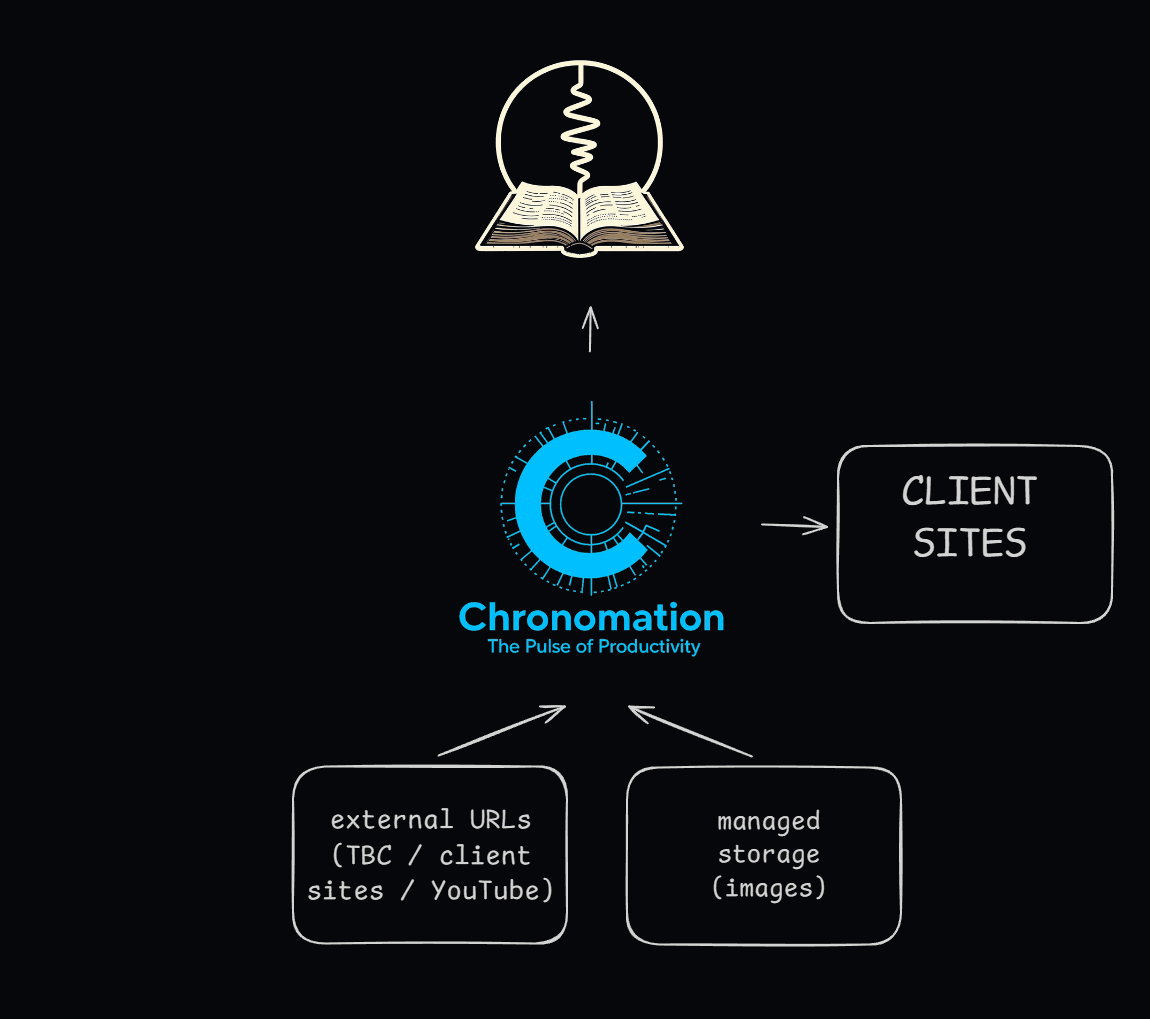
Designing Media Hosting for The Builder Coil
How I’m designing media hosting for The Builder Coil and Chronomation: from simple file-based images to multi-tenant media for future clients.

Chronomation: Key Architecture Decisions
A deep dive into the architecture decisions behind Chronomation – our multi-tenant content engine. Why we chose Neon, Drizzle, and a tenant-first data model.